
|
|
||||||||||
A Visual Guide to Understanding Digital Storage Sizes
We'll compare units of data to containers of rice
Keywords:
storage, digital, information, data, documents
Key Takeaway:
Digital storage is measured in bytes, the
fundamental units that determine how much information your devices can hold —
photos, documents, apps, videos, games, and everything in between.
Category Insights:
BEGINNER — This article is written to be accessible for newcomers to the
topic.
Digital Storage Explained
Digital storage is measured in bytes, the fundamental units that determine how much information your devices can hold — photos, documents, apps, videos, games, and everything in between. But because bytes scale exponentially, most people struggle to visualize what these numbers actually mean.
To make the scale intuitive, we compare each unit of digital storage to rice — a simple, familiar physical object that grows from a single grain into cups, bags, trucks, ships, cities, states, and even oceans. This analogy gives you a real sense of just how massive modern data storage has become.
Binary: The Foundation of All Digital Data
Computers store and process information using binary which is a base-2 numeral system. You may have covered binary in high-school. If you have ever taken a computer science course, you'll know that binary is a system made of only two values: 0 (off) and 1 (on)

Have you ever looked at a power button on a device? That symbol is actually a binary representation of the numbers 0 and 1. The circle represents 0 (off), and the line represents 1 (on).
A bit is one of these binary values — the smallest possible unit of digital information. Think of a bit as a single grain of rice: tiny, but essential. You can also think of it as a light switch that can be either on or off. Eight bits form a byte, and from there the scale grows rapidly.
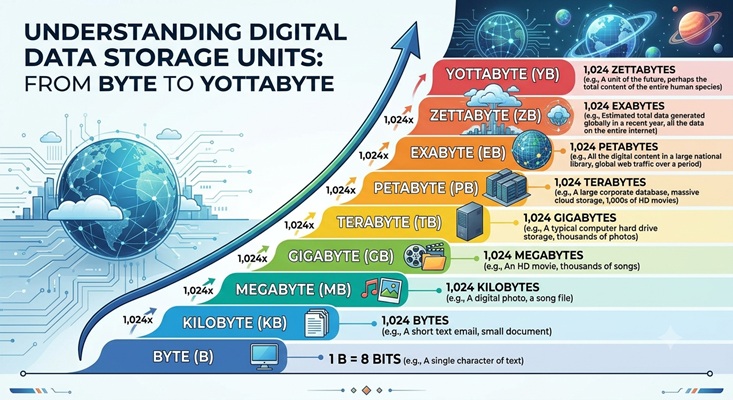
| Unit | Equivalent |
|---|---|
| Byte | 8 bits |
| Kilobyte | 1,024 bytes |
| Megabyte | 1,024 kilobytes |
| Gigabyte | 1,024 megabytes |
| Terabyte | 1,024 gigabytes |
| Petabyte | 1,024 terabytes |
| Exabyte | 1,024 petabytes |
| Zettabyte | 1,024 exabytes |
| Yottabyte | 1,024 zettabytes |
Let’s translate each of these into something you can actually picture.
From a grain of rice to an an ocean of rice: A Human-Friendly Data Scale

Bit → A Speck of Rice Dust
A bit is the smallest possible piece of digital information.
Physically: a tiny speck of rice dust.
Byte → One Grain of Rice
A byte stores one character — a letter, number, or symbol.
Physically: one grain of rice.
Storage Media - Devices as compared to rice
Floppy Disk (1.44 MB) → 12 Bags of rice
The classic 90s save icon. Enough for a few documents. However, it’s now obsolete and rarely used. It won't hold a single photo or song today.
CD-ROM (700 MB) → 5,600 Bags of rice
Its capacity is enough for software, albums, and older PC games, but it’s now largely replaced by digital downloads and streaming.
DVD (4.7 GB) → 14 Container trucks of rice
These are still commonly used for movies and software, but are increasingly replaced by streaming and downloads.
Blu-Ray (25 GB) → 75 Container trucks of rice
High-definition video and large game installs.
1TB Hard Drive → 2 Container ships of rice
A 1TB hard drive is the most common storage size in home computers today. It can hold:
- Hundreds of thousands of photos
- Thousands of HD videos
- Entire game libraries
- Years of documents and backups
Physically, that’s the equivalent of two fully loaded container ships filled with rice — all stored inside a device small enough to fit in your hand.
Digital Units - As compared to rice
Kilobyte (KB) → A cup of rice
1024 bytes — about a paragraph of text.
Megabyte (MB) → 8 bags of rice
A small photo or short audio clip.
Gigabyte (GB) → 3 Container trucks of rice
Hundreds of photos or a full HD movie.
Terabyte (TB) → 2 Container ships of rice
The scale of a typical home hard drive.
Petabyte (PB) → Enough rice to cover Manhattan
Enterprise-scale storage used by large organizations.
Exabyte (EB) → Enough rice to cover the State of Texas
Massive cloud-provider or telecom-level storage.
Zettabyte (ZB) → Enough rice to fill the Pacific Ocean
Global internet traffic scale.
Yottabyte (YB) → Enough rice to fill all of Earth’s oceans
The next step beyond zettabyte — planetary-scale data.
The Big Picture
From a single grain of rice to every ocean on Earth, digital storage grows exponentially. Understanding this scale helps you appreciate:
- How much data your devices truly hold
- Why backups and cloud storage matter
- How quickly global data consumption is increasing
- The staggering size of modern digital infrastructure
Bytes may be abstract, but rice makes the scale real.
By visualizing digital storage in terms of rice, we can better grasp the scale of modern data. From a single grain to oceans of information, the growth of digital storage is staggering. Understanding this scale helps us appreciate the technology that powers our digital world.
Amazon Links - These are products we recommend
Meyer Computer is an Amazon Affiliate. We may earn a small commission from qualifying purchases made through the links below.Thank you for supporting us!
- PNY 32GB Attaché X USB 3.2 Gen 1 Flash Drive 5-Pack
- SANDISK 32GB 3-Pack Ultra USB 3.0 Flash Drive
- SANDISK 64GB 2-Pack Ultra USB 3.0 Flash Drive
- ASUS Powerful Blu-ray Drive - External
- Lite-On 24X SATA Internal DVD+/-RW Drive
- LG GP65NB78 8X USB 2.0 Super Multi Ultra Slim Portable DVD Drive