
|
|
||||||||||
Big Brother Is Watching: Device Privacy Risks
It's time to fight back!
Keywords:
telemetry, privacy, internet, security,
data collection
Key Takeaway:
Smartphones, computers, printers, streaming
devices, smart speakers, televisions, and even robotic vacuum cleaners
constantly send data back to manufacturers through a process called telemetry.
Category Insights:
SECURITY — Security best practices include strong passwords, MFA, and regular
patching.
Intro
Public attention has recently fixated on the controversy surrounding Flock
Safety license plate cameras, with privacy concerns taking center stage. But while
neighborhood surveillance rightfully sparks debate, the hardware inside our own homes is
harvesting far more personal data than most people realize. We usually think of "spyware" as
malicious malware secretly planted by hackers. In reality, the everyday tech we willingly
buy—smartphones, PCs, printers, streaming devices, smart speakers, TVs, and even robot
vacuums—is constantly beaming detailed behavioral data back to manufacturers through routine
background "telemetry".
Telemetry is data collected by a device and transmitted over the Internet, often without the user fully understanding what information is being gathered. This data may include browsing habits, viewing history, search activity, voice recordings, hardware performance, location information, and much more.
This is a real eye opener!
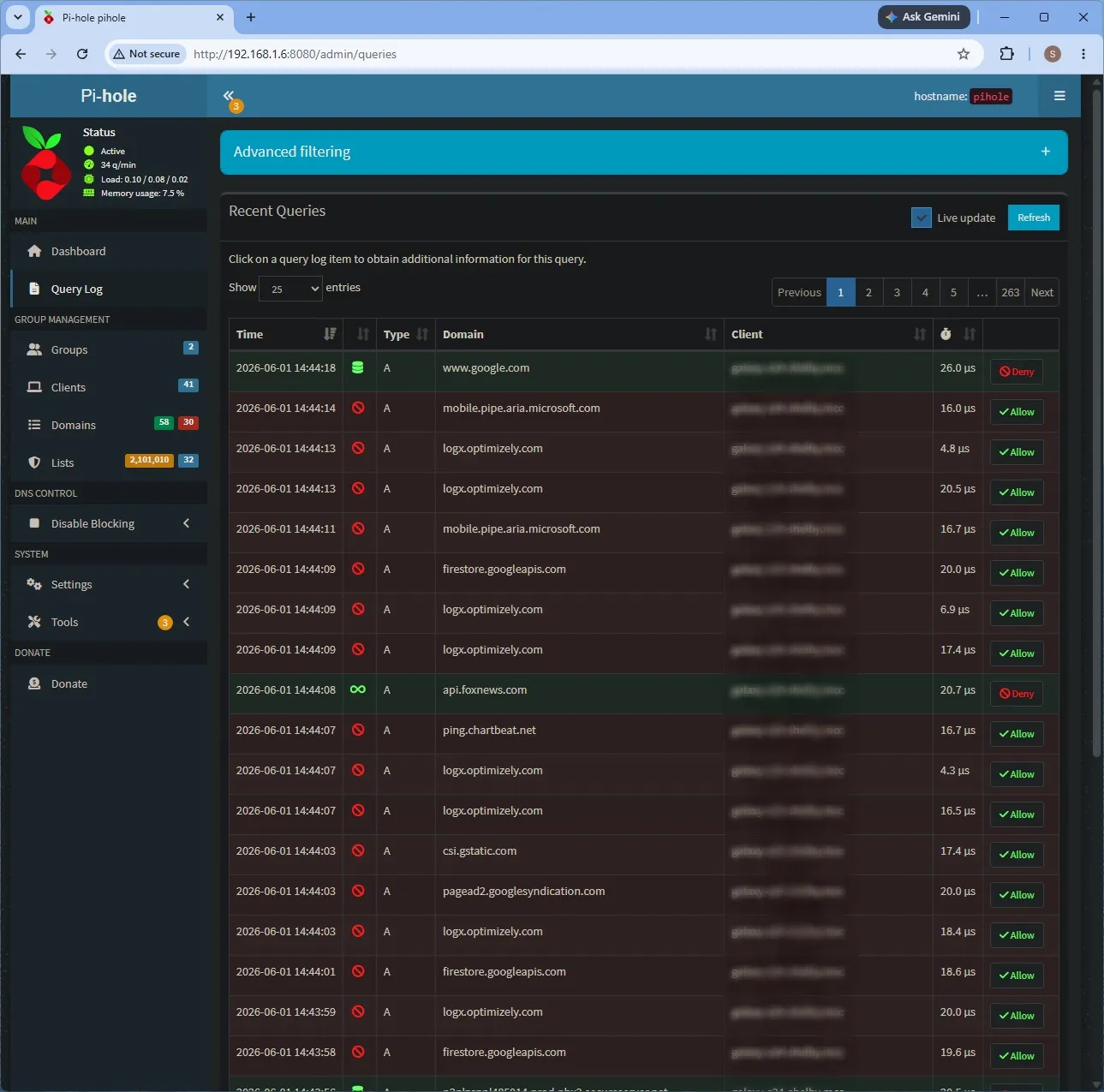
This screenshot was taken from Pi-Hole ad and telemetry blocking software.
It shows tracking requests in red being blocked to a single cellphone over a 1 minute
period. It also shows tracking data from a number of data-collection domains that
you likely never new existed. Imagine this happening with every internet connected device in
your household or business!
What many people do not realize is that consumers are actually paying for the internet
bandwidth being used to send/receive the information being used to track you. While
you pay your monthly Internet bill, large technology companies use your connection to gather
valuable data that helps them improve advertising, track user behavior, and increase
profits.
Nearly Every Major Tech Company Collects Data
Telemetry collection has become standard practice across the technology
industry. Companies such as Microsoft, Google,
Apple, Yahoo, all the streaming services and more will
collect information about websites you visit, applications you use, searches you perform,
and even how long you stay on certain pages. This information helps build advertising
profiles that can be sold to marketers, data brokers or used to target personalized
ads.
The search engines are the so-called 'free' service. Your personal information is
the product thats being sold to other companies. This is how they make
money.
Hardware manufacturers such as HP, Dell,
Lenovo and others also collect system performance information from their
devices. While some of this data is used for diagnostics and troubleshooting, it can also
reveal how customers use their computers, what hardware they own, and how frequently the
systems are active.
Printer companies have become especially aggressive with telemetry collection. Manufacturers
such as HP, Brother, and Epson often
track ink and toner usage. Some printers can detect whether third-party cartridges are
installed and may display warnings or disable certain features. I have personally observed a
printer sending network traffic at the rate of once a minute! Users will typically receive
pop-up advertisements encouraging them to order replacement cartridges directly from the
manufacturer.
Smartphones and smart TVs gather even more information. Modern televisions can track which
channels you watch, how long you watch them, and what streaming applications are being used.
Some smart TVs even analyze voice commands and viewing habits to improve advertising
recommendations.
Regulators are tightening the leash on display manufacturers over unauthorized data
collection and bloatware bundling. LG was recently fined $1.2 million for silently
harvesting user viewing data, while simultaneously facing scrutiny for installing
unauthorized McAfee software via its monitors. With competitor Samsung under similar fire
and public backlash escalating, the Federal Trade Commission (FTC) issued a clear directive
to smart TV manufacturers, reinforcing that data collection without explicit user consent
will no longer be tolerated.
In all likelihood, companies like Google know more about you than the FBI does. They know
what you search for, what you buy, what you watch, and even where you go. If you value your
privacy, it would behoove you to take steps to block as much of this behavior as
possible.
Windows 11 and Telemetry Collection
Windows 11 has also raised major privacy concerns among users because of the
amount of telemetry built directly into the operating system. Microsoft collects diagnostic
data that may include hardware information, application usage, browsing activity,
search behavior, typing patterns, location information, and system performance data.
Some telemetry features can be reduced or disabled through the Privacy and Security
settings menu, and advanced users may also use Group Policy settings, registry changes,
or third-party privacy tools to limit data collection even further. However, many experts
believe that not all telemetry can be completely disabled in the standard consumer
versions of Windows 11. Certain background services continue communicating with Microsoft
servers even after privacy settings are adjusted. Microsoft states that this information
helps improve security, stability, and user experience, but critics argue that users
should have more control over what information leaves their computers.
There are some third-party tools available that can help reduce telemetry collection in
Windows 11, but users should exercise caution and research these tools thoroughly before
using them. It's important to understand the potential risks and benefits of any software
that modifies system settings or disables built-in features. I may write an article that
discusses these tools in more detail.
Reference:
#0090 Opinion Microsoft Why Windows users are getting increasingly frustrated
Streaming Services Know Exactly What You Watch
Streaming platforms collect enormous amounts of viewing data. Services such as
Roku, Amazon Firesticks & Prime Video,
Netflix, Disney+ and the rest, monitor which shows you
watch, how long you watch them, whether you pause or skip scenes, and even which thumbnails
attract your attention.
This information is extremely valuable to advertisers and media companies. Streaming
providers use these statistics to determine which shows are popular, what types of content
should be renewed, and how advertising rates should be set. If millions of viewers stop
watching a program halfway through, executives notice. If users repeatedly binge-watch a
particular type of show, more similar content is likely to be produced.
Targeted advertising has become one of the largest businesses on the Internet. The more
companies know about your habits, interests, and routines, the more valuable your profile
becomes to advertisers.
Smart Devices May Contain Serious Privacy Risks
Many smart home devices are designed for convenience, but they also create
serious privacy concerns. Devices such as Amazon Alexa and Google smart speakers are
constantly listening for wake words. While manufacturers claim the devices only actively
process recordings after hearing a command phrase, concerns remain about accidental
recordings and stored voice data.
Robot vacuum cleaners such as the Roomba can map the layout of your home in
great detail. This information helps the device navigate rooms, but it also creates a
digital floor plan of your house. Security researchers have repeatedly warned that smart
devices connected to the Internet can become targets for hackers.
In one widely reported security incident, A Spanish software engineer accidentally hacked
into 7,000 DJI Romo vacuums globally. By attempting to connect his device,
a severe backend glitch inadvertently gave him global control, allowing him to access
real-time video, microphone audio, and accurate floor plans across 24 countries. Incidents
like this demonstrate how poorly secured Internet-connected products can become major
privacy risks.
In May 2026, there have been reports involving Yarbo robotic lawn mowers
and snow blowers sharing sensitive information such as Wi-Fi credentials and live-video with
overseas servers.
The 'Fine Print'. Even when data collection is described in lengthy privacy agreements, most
users never read the terms before clicking “Accept”. How many of these agreements have YOU
actually read?
Wi-Fi Routers Can Detect Movement Inside Your Home
Modern Wi-Fi technology is capable of much more than simply providing Internet access.
Researchers have demonstrated that ordinary Wi-Fi routers can function almost like a
radar system by analyzing how wireless signals bounce around rooms, walls, furniture,
and people. Changes in those radio waves can reveal when someone is walking, sitting,
falling, or moving from one room to another, even through walls and closed doors, all
without using traditional cameras or microphones.
Some companies are already marketing this technology for home security, smart home
automation, and elder care monitoring because it can detect movement while remaining
less intrusive than video surveillance. However, privacy advocates warn that this creates
another powerful form of monitoring inside private homes. As smart homes become increasingly
connected, the amount of data generated about a household’s daily activities continues to
grow.
Researchers at Carnegie Mellon University and several major technology companies have
published studies demonstrating how standard Wi-Fi signals can be used for motion tracking
and human detection using ordinary wireless hardware. While the technology may sound
futuristic, some newer routers and smart home systems are already capable of limited motion
sensing using standard Wi-Fi equipment.
How to Monitor What Your Devices Are Doing
Many users have no idea how much information their devices transmit every day.
Fortunately, there are tools available that can help monitor network traffic and identify
suspicious activity.
One popular tool is Wireshark, a free and powerful network analyzer used by
IT professionals and security researchers. Wireshark allows users to inspect network packets
and see exactly what devices are sending and receiving over the Internet. It can reveal
unexpected telemetry traffic, hidden background communications, and connections to
third-party servers. It must be stated that this tool is intended for IT professionals and
requires knowledge and the ability to interpret what your seeing. It's extremely revealing
for those who know where to look.
Another useful tool is Pi-hole, which acts as a network-wide advertisement
and tracking blocker. Pi-hole provides logging features that show which devices are
attempting to contact tracking domains. While it is considerably less detailed than
Wireshark, it is much easier for a person with a knowledge of basic networking to
understand. It can help reduce unwanted telemetry traffic across an entire home
network.
Of course, these are not the only choices. There are several others, available and many of
them are command line only such as tcpdump and Tshark.
Microsoft makes a Windows based program called Microsoft Message Analyzer.
At the beginner level, your only real choices are the basic filters found in common
anti-virus software. However, these lack any real detail.
Reference:
ReviewPi-Hole Internet ad-blocker, web filter, w/optional DHCP & DNS capabilities
Can You Completely Stop Telemetry?
No.
Completely avoiding telemetry in modern technology is extremely difficult. Many
devices and online services depend on cloud communication to function properly. However,
users can reduce data collection by changing privacy settings, disabling unused smart
features, limiting app permissions, using privacy-focused browsers, and blocking tracking
domains through network filtering tools.
Some users choose to install alternative operating systems such as Linux to reduce data
collection from large corporations. Others avoid smart devices entirely or disconnect them
from the Internet whenever possible.
The reality is that convenience often comes at the cost of privacy. The more connected our
homes and devices become, the more information is being collected about our daily
lives.
If your serious about your privacy and security, I urge you read our blog post on layered
network security. Here you will find an outline of steps you can take to safeguard your
information from multiple angles.
Reference:
#0098 Security Layered Network Protection for Home or Small Business
Final Thoughts
Technology companies argue that telemetry improves products, fixes bugs, and
creates better user experiences. In some cases, that is true. However, consumers should also
understand that their devices are constantly collecting information that can be used for
advertising, analytics, and behavioral profiling.
The next time you use a smart TV, streaming device, voice assistant, or connected appliance,
remember that it may be collecting far more information than you realize. In today’s
connected world, Big Brother is no longer science fiction. It may already be sitting in your
living room.
Amazon Links - These are products we recommend
Meyer Computer is an Amazon Affiliate. We may earn a small commission from qualifying
purchases made through the links below.
Thank you for supporting us!
- GL.iNet GL-SFT1200 Opal Travel Router, AC1200 Dual-Band Wi-Fi
- GL.iNet GL-MT3000 Beryl AX Wi-Fi 6 Travel Router
- GL.iNet GL-BE9300 Flint 3 Tri-Band Wi-Fi 7 Router
- Malwarebytes Standard, Premium Security| 18 Months, 2 Devices | PC/Mac
- Malwarebytes Standard, Premium Security | 1 Year, 5 Devices | PC/Mac
- Malwarebytes Standard, Premium Security | 1 Year, 10 Devices | PC/Mac
- Bitdefender Total Security - 3 Devices | 1 year Subscription | PC/Mac
- Bitdefender Total Security - 5 Devices | 1 year Subscription | PC/Mac
- Bitdefender Total Security - 10 Devices | 1 year Subscription | PC/Mac